Deep Sky & Stellar
Deep Sky Wonders
Welcome to the deep sky and stellar section of my gallery. Here, you'll find a collection of images capturing the awe-inspiring beauty of stars, distant galaxies and nebulae. From the intricate structures of star-forming regions to the grandeur of spiral galaxies, these photos reveal the vast and diverse universe beyond our solar system.
Immerse yourself in the wonders of deep space as seen through my telescope. Enjoy the journey through the cosmos!

Tried my hand at taking DLSR images on 2nd April 2025. I was using a Canon 300D camera with a Skywatcher Star Adventurer Mini WiFi tracking mount. Image shows Mars at centre with Castor and Pollux of the Gemini constellation. 10 frames, each 60 sec at ISO 1600. Aligned and stacked using Sequator.

Nova Cassiopeia 2021, also known V1405 Cassiopeia, was a nova in the constellation Cassiopeia. It reached a peak brightness of magnitude 5.5 on May 9, 2021, making it visible to the naked eye. In this image, M52 cluster can be seen in the centre and the Bubble Nebula can be seen in the lower right.

Between the constellations of Monoceros and Canis Major. I was happy with this one. 1st Jan 2020

More digging in old files, unearthed this image which gave me an opportunity to try some more processing ideas. NGC 7635, also known as the Bubble Nebula, is an H II region emission nebula in the constellation Cassiopeia. It lies close to the open cluster Messier 52. The "bubble" is created by the stellar wind from a massive hot, young central star. The nebula is near a giant molecular cloud which contains the expansion of the bubble nebula while itself being excited by the hot central star, causing it to glow. It was discovered in November 1787 by William Herschel.

I had another go at this object using my SXV-H9 camera and better focusing that last time. Definitely better resolution. The Flame Nebula, designated as NGC 2024, is an emission nebula located approximately 1,350 light-years from Earth in the constellation Orion. It is part of the larger Orion Molecular Cloud Complex and is known for its striking flame-like appearance, characterized by dark dust lanes. The nebula is a significant region of star formation, containing young stars and brown dwarfs, and is illuminated by the bright star Alnitak, which is part of Orion's Belt.

The Fish Head Nebula, or IC1795, is part of a large star forming system of gas and dust. The nebula is located in the Constellation Cassiopeia, approximately 6,000 light-years from Earth and is adjacent to the much larger Heart Nebula. Good seeing allowed me to capture this image. 23rd Feb 2019

The Pacman Nebula (NGC 281) is a large emission nebula appearing near the orange giant Schedar in the constellation Cassiopeia. The nebula lies approximately 9,200 light years away. 22nd Feb 2019

Careful attention to focusing and a better tracking setup resulted in this image. This is an HaRGB format. Ha was made up of 15 x 10mins binned 1x1 and the RGB were 4 x 5mins each. Alignment and processing using MaxImDL. I added the diffraction spikes as an effect. Feb 3rd 2016

M13 again. A better tracking setup and more care in processing resulted in this image. Feb 2016

NGC 2264 is the designation number of the New General Catalogue that identifies two astronomical objects as a single object: the Cone Nebula, and the Christmas Tree Cluster. The Christmas Tree star formation consists of young stars obscured by heavy layers of dust clouds. These dust clouds, along with hydrogen and helium are producing luminous new stars. The combination of dense clouds and an array of colours creates a colour map filled with varying wavelengths.

Tried a longer exposure and more careful colour balancing. 10th June 2014

Never get tired of this object. The Orion Nebula, one of the most magnificent and well-studied nebulae in the night sky, can be beautifully captured using the SXV H9 camera so I had another go. 20th March 2014

I recently found some image files that I had taken four years ago but had not processed. Exposures were 20 of 10 minutes each for the luminance and10 x 5 minutes each for the red, green and blue. Taken with the Starlight Xpress SHV-H9 camera attached to my 250mm telescope working at f8. Guiding was achieved using my piggybacked f10 refractor. Colour processing done with MaxIm DL. My best result yet of this gem!

Taken with my SXV-H9 camera. The Witch Head Nebula, also known as IC 2118, is a faint reflection nebula located approximately 900 light-years away in the constellation Eridanus. It is illuminated by the nearby supergiant star Rigel in Orion, giving it a distinctive appearance that resembles the profile of a witch's face, complete with a long nose and pointy chin. The nebula is believed to be an ancient supernova remnant or gas cloud.
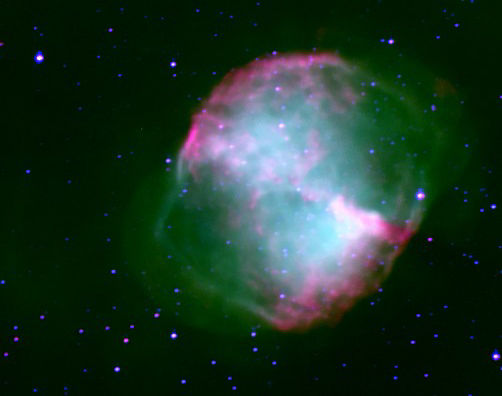
I used this target to try my hand at narrowband imaging using H-alpha, OIII and SII filters. The idea is to use these narrow filters to determine the concentration of ionised hydrogen, oxygen and sulphur in deepsky objects. The process involves imaging the target using the separate filters, assigning a colour to each filter and then combining the separate images into the final tricolour one. In this case hydrogen is red, oxygen is green and sulphur is blue. This planetary nebula target shows the predominance of hydrogen and oxygen in the expanding shell after the original star exploded. Processed on 13/10/2009. I purposely overprocessed the image to enhance the colours for effect.

The same technique as used below was performed on this emission nebula in the constellation Sagittarius. Typical exposures were 400sec and 10 of these were averaged using the H-alpha, OIII and SII narrowband filters. The narrow filters only allow 656nm wavelengths to pass for ionised hydrogen, 495.9 and 500.7nm for doubly ionised oxygen while the SII filter allows only wavelengths around 675nm to pass. Again the complex gas cloud can be seen with these elements in various concentrations and dark dust lanes weaving throughout. This is an active star forming region and many stars are being born deep in this nebula. 1st Sep 2009

Separation 11" Taken on 9th Apr 2009

Close double. Separation about 7". Taken 9th Apr 2009

Another fairly close double. Taken 9th Apr 2009

Separation 20". Taken 9th Apr 2009

Nice colour difference. Separation about 35". Taken 9th Apr 2009

Another double with exposure of about 1 second (ensuring that the image was not overexposed). Separation about 35". Taken 9th Apr 2009

Tried my hand at a series of double stars with typical exposures of about 1 second. I took the images through the LX200 at f/8 and then used MaxImDL to process the images. To find the position angle and separation, I used CCDSoft. Just to go a stage further and learn more about the properties of the individual stars, I plotted them on a Hertzsprung-Russell diagram (not shown here). The image here is of STF1082 (a triple) in Canis Minor. Taken 9th Apr 2009

Clusters of stars can be very beautiful too. This is an LRGB image of a cluster in the constellation of Cancer. The bright star in the top left corner is SAO98178. Exposures were 10x10 sec for the L, R, G and B subframes and taken through the 254mm LX200 SCT at f/8. Processing was by MaxImDL. Taken 2nd April 2009

The western element of the famous Veil Nebula. Format as below with exposures of 12x10min for the Ha and 4x5min for the R, G and B. Taken via the ED80 refractor and processed with MaxImDL and PS. A certain amount of haze resulted in the lack of contrast in some areas. Oct 20th 2007

This is an HaRGB format. The H-alpha frames were taken in November 2006 and the RGB colour information was only added at the end of October 2007. Ha was made up of 15 x 10mins binned 1x1 and the RGB were 4 x 5mins each. Alignment and processing using MaxImDL. Taken with the SXV-H9 camera through my ED80 refractor working at f/5.

This image was taken without any guiding as my guide camera was faulty. The LRGB format was a combination of one hour of luminance using 2 minute unguided subframes together with R,G and B colour of 10 minutes using 2 minute subframes. Taken 16th Oct 2007

Taken on 2nd June 2007 with my SXV-H9 through an ED80 refractor working at f/5. HaRGB format with 2x2 binning on all channels. Total of 60mins exposure on Ha with 15 mins on each of the colour.

Located in the Constellation of Cygnus, this nebula covers a wide area and too big to fit on my camera chip so I concentrated on the Gulf of Mexico area. The sequence of images was taken on 1/11/06 but I only processed them recently. The images were taken via my ED80 refractor working at F4.7 and comprised of 11 Ha subframes of 10 minutes each followed by 8 subframes of R, G and B which were 5 minutes each. The Ha was taken at a 1:1 binning and the R, G and B were at 2:2 binning. All image acquisition and processing was done with AstroArt 4. Taken 13th Jan 2007

Had another go at finding my limits of imaging distance. The above image is of a Quasar by the name of SDSS J161705 +443522 which has a redshift of 5.49 and with a light travel time of 12.6 Billion Light Years. It was taken through my 10 LX200 scope on 29th August 2006 and was an average of 5 ten minute exposures. I think this is likely to be my distant object limit for the present!